

Kinji Fukasaku: Japanese Chaos!

3 CommentsShareCategory:J-Cinema

Kinji Fukasaku: Japanese Chaos!

Few points to understand Kinji Fukasaku’s movies:

First, you have to remember Fukasaku’s background. When the Japan lost the war, he was 15. Cities had been destroyed by massive bombs attacks, and people had to find a way to survive. A difficult period, reinforced by the American Occupation.

So now think about what can feel this 15 years old boy, and it gives you the main points of Fukasaku’s Cinema: violence becomes normal (to survive), changing times and values (Americanization of the country), group ideal (alone, you’re nothing), society’s taboos (the Defeat, yakuza & the economy, lost youth).

Battle without honor and humanity - Tribute to the dead
Tribute to the dead

- Violence: In the ruins, chaos is king. A black market has been developed by yakuza (an underworld market, no pity), prostitution has become the only way to live for women (add the rapes), a bad feeling exists among the population (about defeat and occupation) and above all, there is no trace of order (ruins). So the only way to live is to fight and “win” your food. Everybody tries to make his living, by any ways.

To translate this chaotic urban violence to screen, a hand-held camera is used, like documentaries – no studio’s set, just the street reality. Also it brings images to life, with always a movement. That way we haven’t time to understand what’s happening, it’s pure chaos. But this mise-en-scène would be nothing without the characters, those violent pigs are always swimming in a recent massacre’s blood. They love to fight and kill. To emphaze this reality, Fukasaku decides to use freeze frames, during a gun shoot for example. We can’t ignore this violence anymore.

Japan Organized Crime Boss - Modern Yakuza
Modern Yakuza

- Changing times & values: The traditionnal ideal is now useless. During the reconstruction period, men have learned to first satisfy their own interest, what matters is their lives. In this daylife fight, there is no place for morality or honor. That’s why a savage individualism is rising, ready to do anything to get money, power. In this case, no question to follow the path of honor or mutual respect, it’s an invisible war.

Tradition is nothing more than a formality, a ridiculous mask hiding a merciless reality. For example, why a politician should fight organized crime to keep his integrity clean when he can directly pay the underworld to get peace? Money erase honor. Yakuza become business men! (See Japan Organized Crime Boss, Sympathy for the Underdog)

Yakuza Papers #3 - The Group
The Group

- The Group Ideal: Meaning unity and trust. In order to live on, it’s better to be a part of a group, knowing you can trust other people, than being totally alone. Between 1968-1978, Fukasaku has never stopped to film this group, this human construction. Just look at the visual composition of each shots, every characters belong to this construction. It represents clearly the unity on screen. But why an ideal? With this human construction, whoever you are, whatever you did or thought, you are still welcomed.

In fact, it gives you the chance to really be something, to exist. Whereas outside of this construction, you are nothing, nobody cares about you. The climax of this idea is the Yakuza Papers series, but it’s also where Fukasaku starts to doubt about it. Because the group becomes more and more impersonnal, like a load of sheep, from where a unique sad souvenir remains of this ideal (See Graveyard Of Honor).

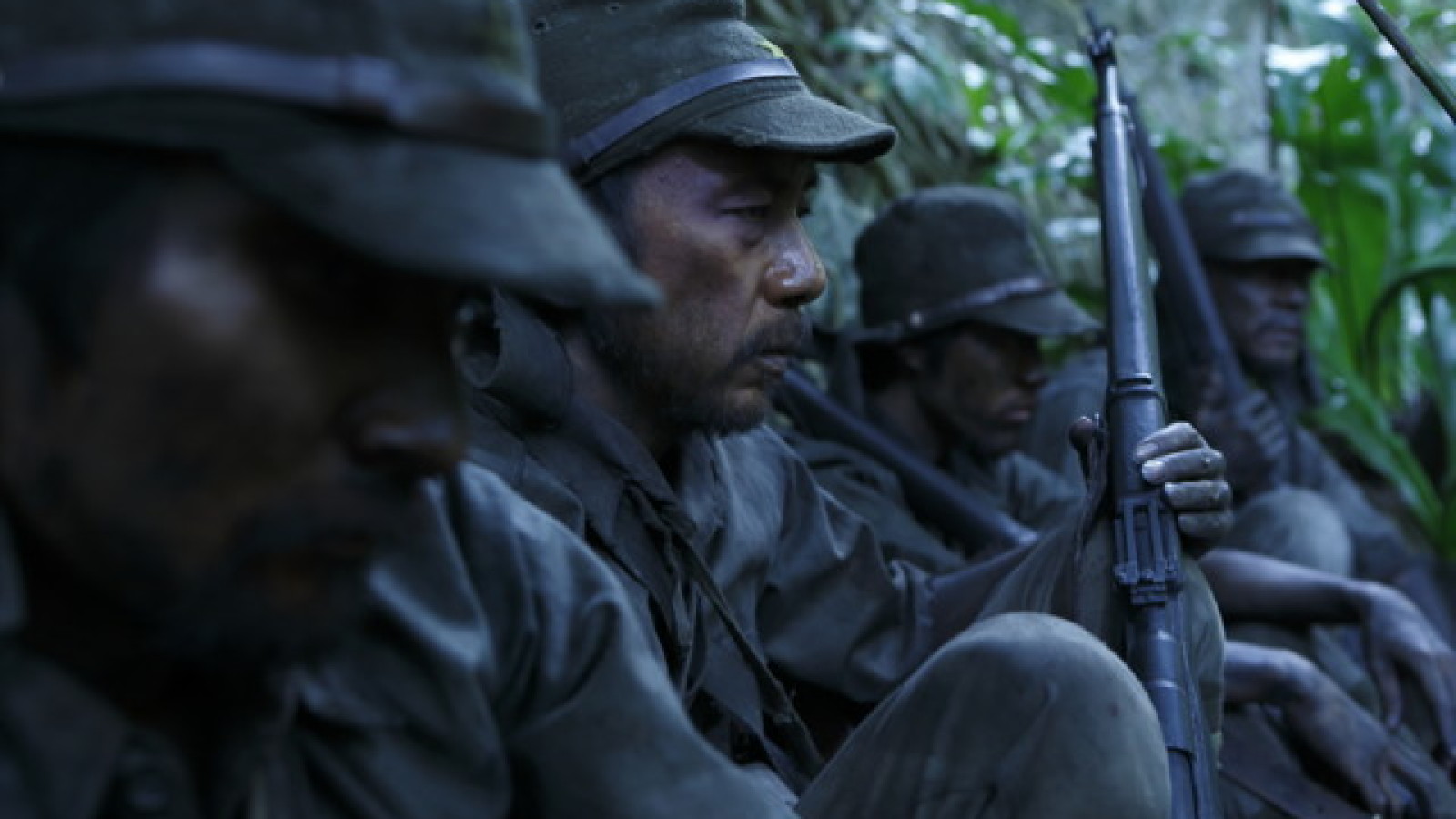
Under the flag of the rising sun - Soldier's Heroism
Soldier’s Heroism

- Taboos: Despite times changing, society has never tried to face his fears. Starting with the 1945′s defeat, including all the horror atrocities, the 2 atomic bombs and the after-war chaos. Fukasaku wants to confront those war taboos with reality: for example the difference between the reality of japanese soldiers in 1945 and the myth created during the 70′s. As a result, he notices how dead soldiers became great and honorable heroes (See Under the flag of the rising sun), and how war reality was forgotten (like cannibalism, idealogical blindness, massacres).

In front of the A-Bomb Dome, how can you talk about heroism? That’s why, this dome becomes a regular motif in the Yakuza Papers series, shown either at the beginning or at the end or each movies, it reminds a forgotten horrible past in a society pleased by his economic boom.

Who’s behind this boom? Yakuza, everywhere! The underworld owns key companies and markets (like ports) and pay high rank politicians as well as the police (corruption). Yakuza are at the heart of the economical system, society can really be proud! With so much taboos and hypocrisy, what can do the youth?

In this nihilistic period, without identity or real values (except money), a part of the youth becomes interested by the old past ideology (like Yukio Mishima), thinking it can brings solid strong answers to this empty period. After all, that’s what the Emperor is doing each years, isn’t it? Showing heroism of the glorious dead soldiers? Another part of the youth can’t find a way to live in a difficult economical reality, they have no future. So instead of fighting to get a honest job, this youth chooses the illegal way, like blackmailing (See Blackmail is my life, If you were young : Rage !).

More than ever, Fukasaku is showing a divided and irresponsible society living in corruption, lies. Welcome in Japan!


Share This!


Check Out These Articles

{ 3 comments… read them below or add one }

1 joshua sandico May 31, 2009 at 3:19 am

good day to the webmaster of this site uhm…i’m reaaly a fan of Kinji Fukasaku’s works but i’m kinda disaapointed that you didn’t include torah! torah! torah that is primarly known in the west co’z that film have great contribution on the global cinema

and also if ever you torah torah torah! kindly send me the filmography of that famous art film

Reply

2 olivierh December 3, 2009 at 1:08 am

Fukasaku Kinki just directed some parts of Tora ! Tora ! Tora !, that’s probably why it wasn’t mentionned. Anyway, with the money taken from Tora Tora Tora, Fukasaku was able to buy the rights and to shoot ” Under the Flag of the Rising Sun”. Good idea to insist on the “chaotic” aspect of his work & world. I wrote this (in french) about Fukasaku : http://www.editions-harmattan.fr/index.asp?navig=catalogue&obj=livre&no=30036.

Reply

3 Martin December 3, 2009 at 5:49 am

Il est dommage que les méthodes de com’ francophones soient si archaïques et se résument à de simple commentaires sur des sites spécialisés. Ces sites seraient aussi sans doute interressé à promouvoir dans le détail de tels ouvrages qui s’annoncent bigrement interressant!

Reply

Leave a Comment

Previous post:

Next post: