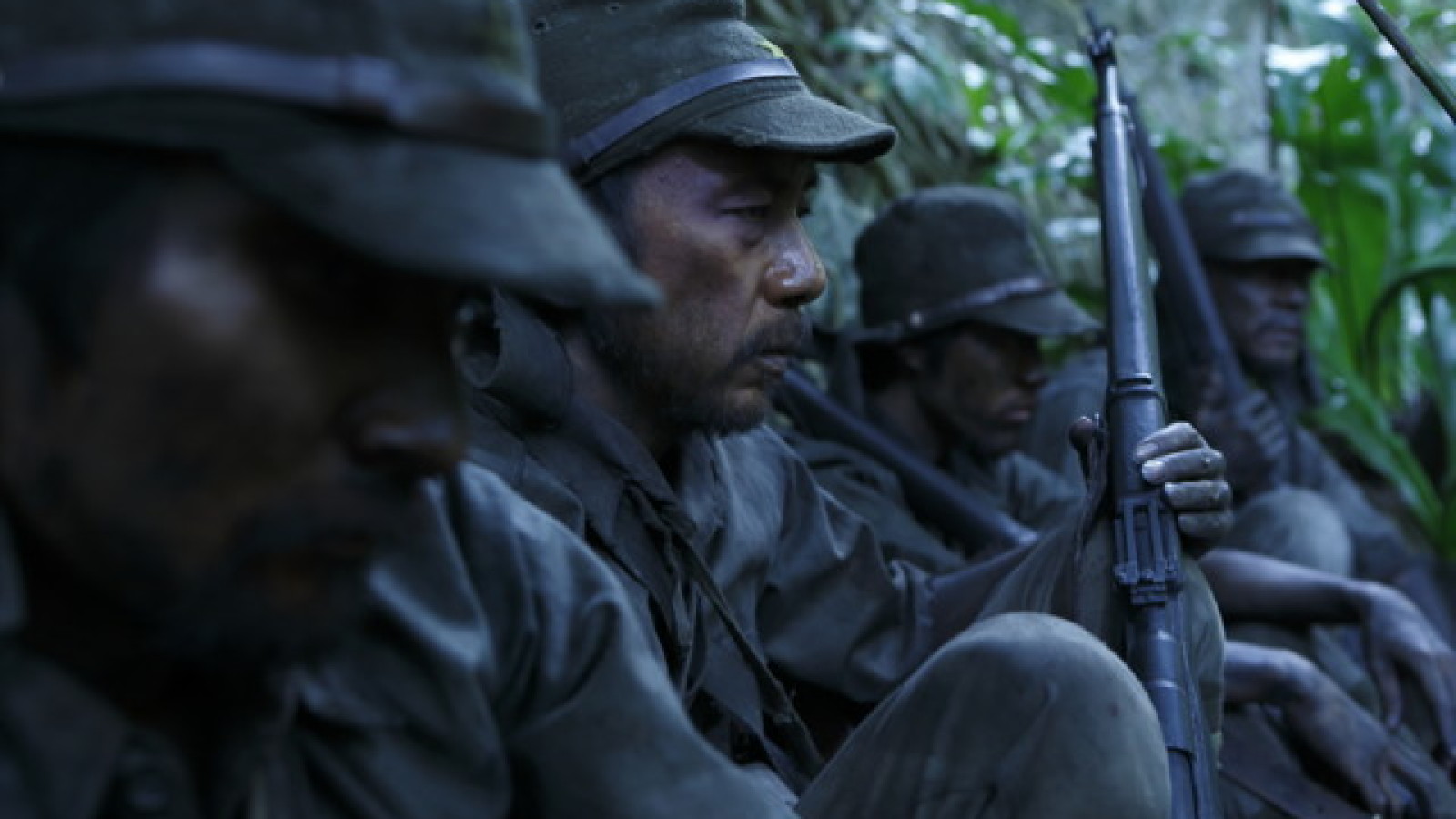
One month after having seen it, I still can’t get City of Life and Death out of my mind and especially this weird f-cked up scene. I was wondering if any of you have an idea about the ceremony shown in this scene. Like what’s the name of a ceremony using large drums in Japan? When is it perfom? Basic questions about the Japanese Culture in fact!
(And it seems no western distributor has picked up right for this. WAKE UP GUYS!! After Red Cliff, this is maybe the other best chinese film released this year, so far.)
If you enjoyed this article, keep updated!


{ 6 comments… read them below or add one }
(From wiki)
Uses of the taiko (drums) in warfare
In feudal Japan, taiko were often used to motivate troops, to help set a marching pace, and to call out orders or announcements. Approaching or entering a battle, the taiko yaku (drummer) was responsible for setting the marching pace, usually with six paces per beat of the drum (beat-2-3-4-5-6, beat-2-3-4-5-6).
According to one of the historical chronicles (the Gunji Yoshu), nine sets of five beats would summon an ally to battle, while nine sets of three beats, sped up three or four times is the call to advance and pursue an enemy.
————–
Interesting!
I was more thinking of a traditional use as shown in Gosha’s The Wolves (and too bad, Animeigo notes don’t mention anything about it).
Others interesting facts about taiko:
———————————
Religion:
The rumbling power of the taiko has also been long been associated with the gods, and has been appropriated by the religions of Japan. According to Daihachi Oguchi of Osuwa-daiko, about four thousand years ago, in the Jomon period , taiko was used for to signal various activities in the village. Simple taiko beats would be used to signal that the hunters were setting out, or to signal that a storm was coming and that the women needed to bring in the meat and fruits they had drying. While there is no direct physical evidence to support this claim, Megumi Ochi, curator of the Taiko Kan Museum, believes this to be true since other cultures exhibit the same behavior. Because these signals were so important to the flow of daily life, the people were very thankful of the taiko, and began to believe that the taiko was inhabited by a god.
Taiko has continued to find a place in religious ceremonies, both Buddhist and Shinto, and it is extremely common to find taiko in both temples and shrines. In fact, the Nichiren sect is credited with created the uchiwa style taiko, who used it as an aid in chanting. Some Buddhist sects use taiko to represent the voice of Buddhah, and Bon dancing in summer is centered around Buddhist rites. It was used in village Shinto rites to offer up prayers to the Gods.
—————————–
War:
Reputedly, one of the first uses of taiko was as a battlefield instrument; used to intimidate and scare the enemy – a use to which drums have been put in many cultures. Taiko were definitely used in battle to issue commands and coordinate movements by the 1500′s; the taiko being the only instrument that could be heard across the entire battlefield. According to picture scrolls and painted screens of the time, one soldier would carry the taiko lashed to a backpack-like frame, while two other soldiers would beat the taiko, on each side. Both nagado and okedo style taiko were used in this capacity. A war taiko used by Shingen Takeda, a famous warlord of that era, still exists and is preserved by Osuwa-daiko. It is remarkable for the three large holes cut in the side of the nagado style taiko. This served to increase the volume of the drum, useful in battle.
————————————
from http://www.taiko.com/taiko_resource/history.html#research
Don’t you worry, French distributors are aware of this and many other gems – but there are still a few negociations to lead and it’s not always easy… …
That’s cool! Thanks Martin!
While looking for more infos, I’ve discovered this image:
Which happens to be from a real ceremony, honoring the dead, performed by the Japanese Troops in Nanking, 1937 (The Burmese Harp features also that ceremony, to stay cinema-related). Obviously, by adding drums and a special choregraphy, Lu Chuan brings that ceremony to another level. An interesting change!
can’t wait to see this, always been fascinated by nankin, and the iris chang book is really powerful – Poor Iris committed suicide a few years ago.
http://www.irischang.net/
Interesting review from the NYT
http://www.nytimes.com/2009/05/23/world/asia/23luchuan.html
I do hope though this will prove much better than red cliff!!