


Scene Analysis: Harakiri (1962)

# Japanese Movies1 Comment

Scene Analysis: Harakiri (1962)

Let’s see the opening:

Scene Analysis: Harakiri (1962)

First thing is a samurai armor mask, which is the fine japanese warrior spirit. But then, the armor becomes horrible and lifeless, it’s now just a decorative object (slight smoke, horns, hairs…). The point is, it’s an empty symbol. The “fine warrior spirit” is gone!

Scene Analysis: Harakiri (1962)

A narrator starts reading a logbook: The story is set in 1630, the early years of the Tokugawa era. With a crossfading effect, the samurai armor becomes the logbook while the narrator is reading a little (useless) story about the Lord.

Scene Analysis: Harakiri (1962)

Next, we learn a ronin came asking to die. No big deal? Well, at that moment, the book turns into live reality – from words to reality (and also, from darkness to light, which says a lot about Kobayashi’s motivation).

Scene Analysis: Harakiri (1962)

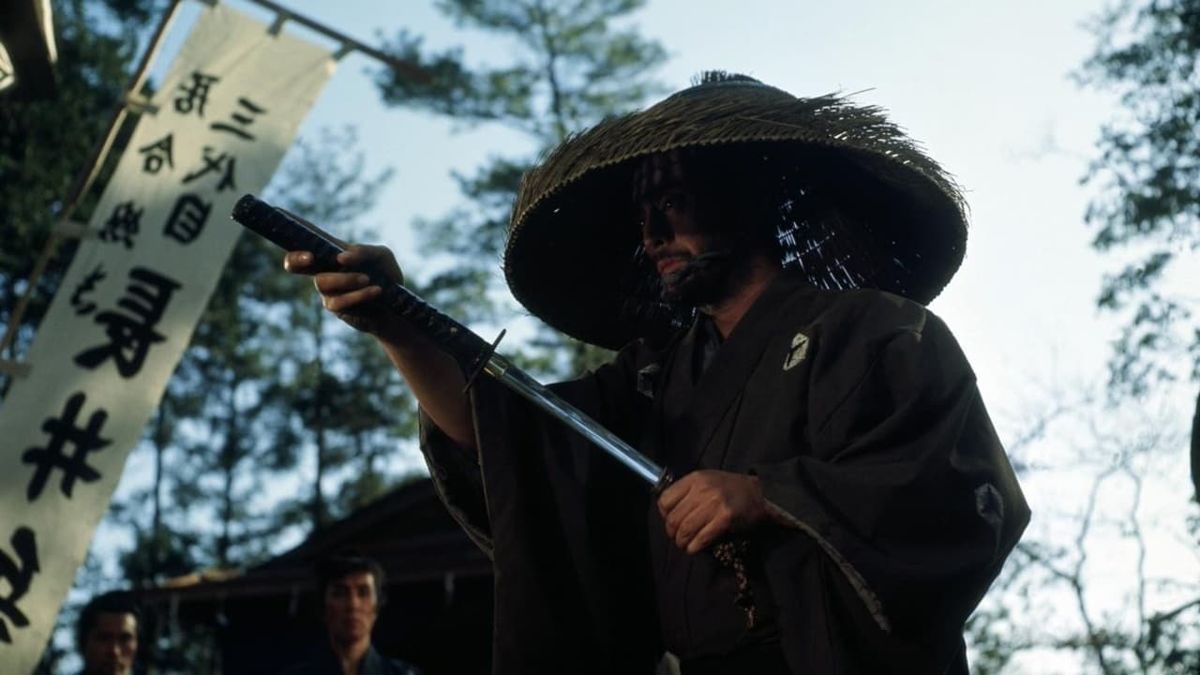
Here, a man comes in front of a mansion. He wears black, we can only see his back, so he seems to be a threat. A feeling underlined by the score, and his “size” inside the frame: first he’s bigger, then, he becomes smaller. As if this society could erase easily any “threats”.

This man is nothing but a ronin, a real renegade. So there’s a big difference between him and this mansion, and moroever, between him and the samurai armor. But Kobayashi isn’t interested by this “official point of view” given by the logbook. That’s why, the camera starts to follow this mysterious ronin.

Scene Analysis: Harakiri (1962)

And when he stops, it seems like the camera has now adopted his point of view: he watched from head to foot the mansion (and from light to darkness, with the screentitle written on the door = a literal harakiri?). This movements reminds us of the one at the beginning (the armor). It links a human symbol (political) and a spiritual symbol. And it also links 2 questions: What’s inside this mansion? What’s inside this armor? It’s pretty clear Kobayashi is criticizing the japanese feudal society.

The answer is given during the credits: Kobayashi presents us the inside of the mansion. It begins with a map, and ends with the famous armor. All along, we can notice the mansion is awfully empty. So we now have the answer: if the mansion is empty, so is the armor!

And what about the logbook, introduced as an intermediary object. Remember, it was linked to the armor (cross-fading effect), and literaly erased by the ronin. By the way, Kobayashi decides to tell us the story of this ronin, which was barely mentioned in the logbook. So why this story? It’s simple, the answer is the movie itself, which is 2 hours long… quite strange for something barely mentioned in a logbook!!

So maybe this story was voluntarily shorten. Maybe the real story was “erased” from archives. Maybe this society prefered to forget this tragedy. And maybe this useless ronin succeeded to scare the Lord… Anyway, the logbook kept record of a gift given to the Lord but nothing about this human tragedy. Which means the Official History is nothing but lies, and so this logbook is a perfect symbol of a corrupted society.

Conclusion
Kobayashi needs only 3 simple symbols (armor, logbook, mansion) to present the Japanese feudal society. We can say with Harakiri, Kobayashi is showing the mask of an empty society… Hey, but that’s the 1st shot! Quite efficient, right?

If you enjoyed this article, keep updated!


{ 0 comments… add one now }

{ 1 trackback }

Leave a Comment

Previous post:

Next post: